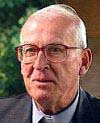
 George Coyne
Director of the Vatican Observatory
George V. Coyne, born January 19, 1933, in Baltimore, Maryland, completed his
bachelor's degree in mathematics and his licentiate in philosophy at Fordham
University, New York City, in 1958. He carried out a spectrophotometric study of
the lunar surface for the completion of his doctorate in astronomy at Georgetown
University in 1962. He spent the summer of 1963 doing research at Harvard
University, the summer of 1964 as a National Science Foundation lecturer at the
University of Scranton, and the summer of 1965 as visiting research professor at
the University of Arizona Lunar and Planetary Laboratory.
A member of the Society of Jesus since the age of 18, he completed the
licentiate in sacred theology at Woodstock College, Woodstock, Maryland, and was
ordained a Roman Catholic priest in 1965. Coyne was visiting assistant professor
at the UA Lunar and Planetary Laboratory (LPL) in 1966-67 and 1968-69, and
visiting astronomer at the Vatican Observatory in 1967-68. He joined the Vatican
Observatory as an astronomer in 1969 and became an assistant professor at the
LPL in 1970. In 1976 he became a senior research fellow at the LPL and a
lecturer in the UA Department of Astronomy. The following year he served as
Director of the UA's Catalina Observatory and as Associate Director of the LPL.
Coyne became Director of the Vatican Observatory in 1978, and also Associate
Director of the UA Steward Observatory. During 1979-80 he served as Acting
Director and Head of the UA Steward Observatory and the Astronomy Department. As
Director of the Vatican Observatory he has been a driving force in several new
educational and research initiatives. He spends five months of the year in
Tucson as adjunct professor in the University of Arizona Astronomy Department.
Coyne's research interests have been in polarimetric studies of various
subjects including the interstellar medium, stars with extended atmospheres and
Seyfert galaxies, which are a group of spiral galaxies with very small and
unusually bright star like centers. (Polarimetry is the technique of measuring
or analyzing the polarization of light. When light rays exhibit different
properties in different directions, the light is said to be polarized.) Most
recently he has been studying the polarization produced in cataclysmic
variables, or interacting binary star systems that give off sudden bursts of
intense energy, and dust about young stars. He is an active member of the
International Astronomical Union, the American Astronomical Society, the
Astronomical Society of the Pacific, the American Physical Society and the
Optical Society of America.
VATT science: Coyne will conduct two programs with the VATT using the
Vatican polarimeter (VATPOL) and a 5-color polarimeter from Finland. The first
is to make more observations of cataclysmic variable stars to understand better
how matter flows from the low-mass companion in the binary system onto the
strongly magnetized white dwarf star. His second program requires the VATT's
very high resolution imaging. Coyne will search for protoplanetary disks of dust
and gas that surround very young stars -- stars in the process of becoming a
main-sequence star like our sun, perhaps giving rise to planets of their own. He
will use an imaging polarimeter to study the scattering of starlight in the
circumstellar material around these young stars.
"We have already discovered that some stars with masses between one and
five times that of the Sun have flattened disks of material about them which
extend from one to ten times the distance from the Sun to Pluto," Coyne
says. "From the way in which this material is distributed, we have some
indication that planets may have already formed in the regions closest to the
new-born star. The evidence is indirect but it is obviously very important. This
could prove to be a completely independent way of searching for planetary
systems about other stars. Since, even for the nearby stars, the sizes of the
disks are at the limit of the resolution of our best telescopes and best
observing conditions, the use of the VATT at the exquisite site of Mount Graham
is very well suited to this problem. Furthermore, we will have to observe a
large sample of young stars in order to begin to establish the frequency of such
disks in stars like the Sun."
|
|
To return to previous topic, click on your browser's 'Back' button.
|
Email
link
|
|
