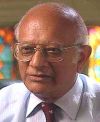
 Rustum Roy
 received B.Sc. and M.Sc. degrees from Patna
University and received his Ph.D. from The Pennsylvania State University. He
was associated with Penn State for sixty-five years as a graduate student and
faculty member. At Penn State he held positions as Evan Pugh Professor of the
Solid State, as Professor of S.T.S., and as Professor of Geochemistry. He also
was a Distinguished Professor of Materials at Arizona State University,
and a Visiting Professor of Medicine at the University of Arizona. He was
appointed and served for 23 years as the first director of an independent
interdisciplinary Materials Research Laboratory in the U.S. He was elected to
numerous national and international scientific academies including the U.S.
National Academy of Engineering. He co-founded the pioneering interdisciplinary
scientific society - the Materials Research Society- and continued to advance
the boundaries of science and technology up to the present, including seminal
research in the emerging field of water science, as well as resonance effects
in condensed matter. An outstanding aspect of his life was his capacity and
dedication to breaking artificial boundaries in order to integrate science,
religion, education, health, art and social action for human benefit. As an
eight year old, in his parent's house he met Gandhi, who discussed with his
father how personal change was more effective for human advancement than
technological change. Professor Roy's solution in life was to pursue both. He
was very active in ecumenical religious life for over 60 years and co-founded
the interdenominational Sycamore Community. His insight into the world's main
religions led him to work to break down the boundaries between Christianity,
Hinduism, Islam, Buddhism and other religions. He served on the Executive
Committee of the National Council of Churches, was a leader in the Kirkridge
retreat center, and was the friend and colleague of many religious leaders
including Bishop John Robinson, John Shelby Spong, Prof. Harvey Cox, Sister
Joan Chittister and Reverend Gordon Cosby.
|
|
To return to previous topic, click on your browser's 'Back' button. |
Email
link |
|



