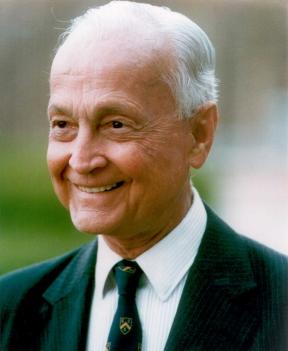
 Sir John Templeton
As a pioneer in both financial investments and spiritual endeavors, John
Marks Templeton has spent a lifetime encouraging open-mindedness. If he hadn't
sought new paths, the native Tennesseean-a fulltime philanthropist at 89-says
"he would have been unable to attain so many goals".
- Beginning a Wall Street career in 1937, Templeton created some of the
world's largest and most successful international investment funds. Termed
"arguably the greatest global stock picker of the century" by
Money Magazine (Jan. 1999), he sold his various Templeton funds in 1992 to
the Franklin Group for $440 million.
- Now a naturalized British citizen living in Nassau, the Bahamas, Templeton
was knighted Sir John by Queen Elizabeth II in 1987 for his many
accomplishments. One of those was creating the world's richest award, the $1
million-plus Templeton Prize for Progress Toward Research or Discoveries
about Spiritual Realities, presented annually in London since 1972.
- And through the John Templeton Foundation, based in Radnor, Pa., he gives
away about $40 million a year---especially to projects, college courses,
books and essays on the benefits of cooperation between science and
religion.
Sir John M. Templeton, a student of benefits from free competition and
disciplined work habits, is not the first wealthy investor to increase his
giving to religion-related causes late in life.
However, his progressive ideas on finance and faith made him a distinctive
figure in both fields, perhaps something of an iconoclast. Not that the
soft-spoken Southerner worries about that.
"Rarely does a conservative become a hero of history," Templeton
wrote in The Humble Approach, one of a dozen books he has authored or edited.
Rather, it is the far-reaching thinker who breaks out of the traditional mold .
. . "one who, according to the accepted customs of his time, might be
branded a heretic."
Taking a less-traveled route in investing, Templeton sold advice on how to
invest worldwide when Americans rarely considered foreign investment.
Standard stock-buying advice is "buy low, sell high." But Templeton
took the strategy to an extreme---picking nations, industries and companies
hitting rock-bottom "points of maximum pessimism," as he put it. When
war began in Europe in 1939, he borrowed money to buy 100 shares in each of 104
companies selling at $1 a share or less, including 34 companies that were in
bankruptcy. Only four turned out to be worthless, and he turned large profits on
the others after holding each for an average four years.
Templeton launched his flagship fund, Templeton Growth, Ltd. in 1954. Each
$100,000 invested then with distribution reinvested grew to total $55 million in
1999.
Although he has been a Presbyterian elder active in his denomination and on
the boards of Princeton Theological Seminary and the American Bible Society, he
espouses a "humble approach" to theology. Declaring that relatively
little is known about God through scripture and present-day theology, Templeton
once predicted that "scientific revelations may be a goldmine for
revitalizing religion in the 21st Century."
The John Templeton Foundation donates to many entrepreneurs, trying various
methods for over 100 fold more spiritual information, especially through science
research to supplement the wonderful ancient scriptures of all religions. For
instance, the ambitious Forgiveness Project launched in 1999 sought to fund more
than $ 10 million in research investigating scientific bases for what religious
traditions have instinctively thought about the salutary effect of forgiveness
on offenders and victims alike.
John M. Templeton was born Nov. 29, 1912, in the small town of Winchester,
Tenn.---a biographical item bearing some irony. A dozen years later in nearby
Dayton, Tenn., the famous Scopes "Monkey Trial" would unfold in a
battle of evolution theory vs. fundamentalist views of Creation. Templeton and
his foundation work on the premise that scientific principles of evolution and
the idea of God as Creator are compatible.
Forced to live thriftily by supporting himself while studying at Yale
University during the Depression, Templeton graduated in 1934 as a top scholar
in his class. He was named a Rhodes Scholar to Balloil College at Oxford from
which he graduated with a M.A. degree in law.
He married the former Judith Folk in 1937 and the couple had three
children---John, Anne and Christopher. She died in February, 1951. He married
Irene Reynolds Butler seven years later on New Year's Eve. She passed away in
1993 after 35 years of marriage.
During a career that included directorships on banks, businesses and
insurance companies, Templeton maintains a long association with the
Presbyterian Church (U.S.A.). He was a trustee on the board of Princeton
Theological Seminary, the largest Presbyterian seminary, for 42 years and served
as its chair for 12 years. He also lent his business acumen to the
Presbyterians' ministerial pension fund for more than three decades until 1993.
Templeton was known for starting mutual funds' annual meetings with a prayer.
He explained that the devotional words were not pleas for financial gain in the
mundane world, but rather meditations to calm and clear the minds of managers
and stockholders.
Templeton has told interviewers that "competitive business," in his
view, matched in many ways the compassionate aims of religious bodies. "For
one thing, it enriches the poor more than any other system humanity ever has
had," he told Insight magazine. "Competitive business has reduced
costs, has increased variety, has improved quality." And if a business is
not ethical, he added, "it will fail, perhaps not right away, but
eventually."
Typical of Templeton's wide-lens view of spirituality and ethics, the
dedicated Presbyterian admits to additional influence from the New Thought
movements of Christian Science, Unity and Religious Science. Those metaphysical
churches espouse a non-literal view of heaven and hell, and suggest a shared
divinity between God and humanity. "We realize that our own divinity arises
from something more than merely being 'God's children' or being 'made in his
image,'" Templeton wrote.
Sir John does not claim credentials as a theologian as much as someone with
enough money to stir new research pursuing further "knowledge and love of
God."
The annual Templeton Prize for Progress in Religion grew out of the
philanthropist's belief that honors equivalent to Nobel Prizes should be
bestowed on living innovators in religious action and thought. Mother Teresa of
Calcutta received the first prize in 1973. Other winners include evangelist
Billy Graham, author Aleksandr Solzhenitsyn and theoretical physicist Paul
Davies, one of several scientists so honored. Hindus, Jews, Buddhists and
Muslims have been on the panel of judges and have been recipients.
The multi-faith framework of the prize calls for "a clearer acceptance
of the diversity of gifts within the major religions of the world,"
Templeton said in 1972 while inaugurating plans for the awards. "We are
indebted to our forefathers who recorded in books their spiritual discoveries
and revelations," he said, "Alive today are other persons to whom God
is revealing further holy truths."
One of Templeton's most recent books, Wisdom from World Religions,
assembles spiritual principles from sacred writings and from the teachings of
Buddhism, Christianity, Confucianism, Hinduism, Islam, Jainism, Judaism,
Sikhism, Taoism, Zen and Zoroastrianism. Examples of the wisdom found in this
rich resource reflect what Templeton says: "An attitude of gratitude
creates blessings, Help yourself by helping others; You have the most powerful
weapons on earth-love and prayer."
|
|
To return to previous topic, click on your browser's 'Back' button.
|
Email
link
|
|